How it worksThe method, week by week
The method: from the company as drawn to the company as built.
Five steps, run inside your organization by forward-deployed engineers and strategy consultants, with your people signing off at every one.
Five Step MethodThe five deliverables you receive
Five steps, five named deliverables.
Step 01: Collecting Data
Read-only connections to the systems you already run, plus the work that never reaches them: spreadsheets, e-mail, chat and paper. Where nobody records the data today, we create it.
One evidence base
Step 02: Mapping Processes and Data Flow
We rebuild how work really flows, case by case, how data moves through the business, and where AI infrastructure and GPU spend go, with an owner at every link.
As-built process map and data supply chain map, with owners
Step 03: Gap Analysis
We test what really happens against your own rules, best practice and the law. Every finding carries a count, the evidence and a named owner.
Findings register (count, evidence, owner, severity) and a compliance matrix: Met · Partial · Not met · No evidence
Step 04: Optimal Design
We match each part of your business to documented best-practice models and design the target processes, controls and approval gates. Your leadership decides.
Target design, a control specification per finding and a 90-day plan
Step 05: Implementation Live Assurance
Checks run on every new case, so drift surfaces as it happens. Your teams run the controls, or we run them for you.
Live checks, exceptions routed to owners and a monthly readout
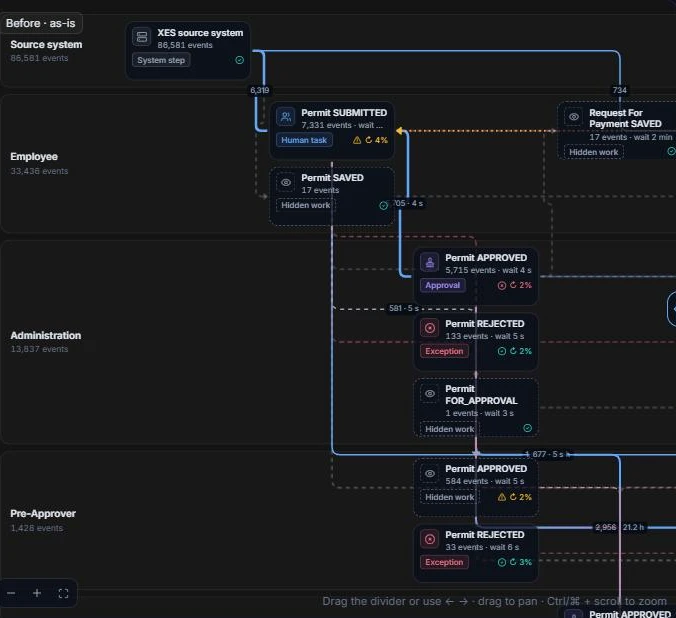
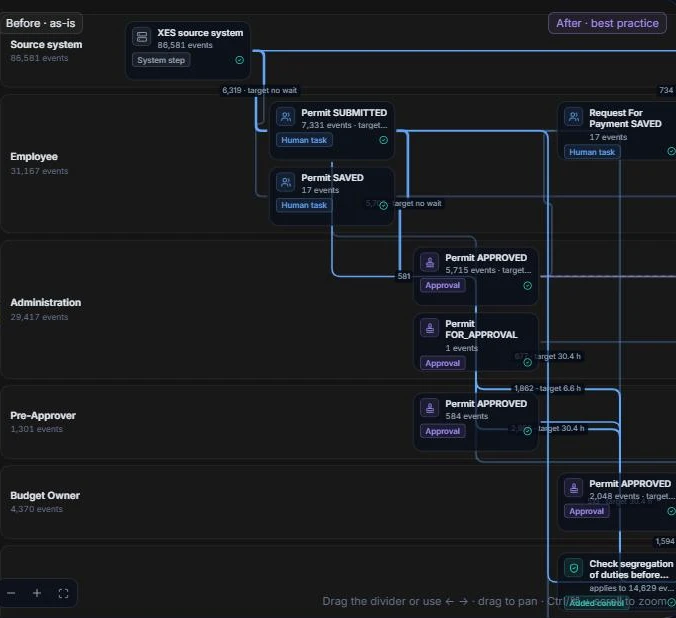
Before and afterOne process, as it runs and as it should run
Drag across the process to redesign it.
The same travel-permit process in Atlas. Before: hidden work, rejections and exceptions, as the records show it really runs. After: the best-practice design, with a segregation-of-duties control added.
Three referencesThe three yardsticks every finding is tested against
Every finding is tested three ways.
Your own policies and procedures
Best practice
ISO, APQC, ITIL, COBIT, EFQM
The law and your regulators
CaptureHow we collect data that no system records
No data? We create it.
Where a person fills the gap today, we embed the capture in their place: OCR for paper, meetings transcribed with consent, photo stations, vision on the shop floor.
Designed for your process; people only on the exceptions.
Recording and vision only with consent, under GDPR and KVKK. Meeting audio is deleted once transcribed.
The people who stayWho does the work inside your organization
Senior people, inside your organization.
Forward-deployed engineers connect, capture and build.
Forward-deployed strategy consultants judge, design and stay through implementation.
TimelineEach stage of the work, in order
What happens, week by week.
Weeks 0–2
Connect
Weeks 2–5
Mapping Processes and Data Flow
Weeks 5–9
Check
Weeks 9–12
Forecast and hand over
Then
Run
Ways to workThe three ways to engage us
Three ways to work with us.
One-Week Proof
One process with its complete data. In one week: the process as built, first findings with owners, and the value at stake.
Full engagement
A company or a business unit, 8–12 weeks, fixed fee, after a useful proof.
Managed service
We keep the model live, with monthly readouts and agents whose every action a named person approves.
Who does whatHow roles split between you and us
You decide. We do the work.
Sponsor
Scope, priorities, investment
Process owners
Approve every finding and every model update
AIx2
Connections, modelling, checks, reporting
Is AIx2 right for you?The conditions we check before we start
We do our best work when the basics are in place.
A due diligence needs data, owners and a sponsor. We check six things before we sign; it protects your budget and our team’s time.
- A core system, ERP or equivalent, in real use for at least two years
- Named owners for your key processes
- Data access signed off by your sponsor before kick-off
- Documented procedures for the main flows
- An executive sponsor with time every week
- At least three years of operations with stable processes
Not there yet? Start with a short readiness check instead of a full diligence.
Ask for a readiness check